
As we approach the halfway point of 2026, investors have already experienced more than their fair share of market-moving headlines. After starting the year strong, markets pulled back amid geopolitical tensions and have since rebounded to new highs.
Times like these serve as a reminder of how quickly markets can react to short-term events—and why maintaining a long-term perspective remains so important.
In a recent Investment Committee update, John Shanley, Partner & Managing Advisor, and Josh Sweeney, Chief Investment Officer, share how Connecticut Wealth Management (CTWM) is evaluating today’s environment and the role disciplined portfolio management continues to play.
Beyond the Headlines: Staying Focused on the Long Term
From geopolitical unrest and oil prices to IPO activity and movements in the technology sector, markets have been highly responsive to headlines this year.
As these developments create substantial short-term volatility, they also reinforce how difficult market predictions are in the near-term.
These factors lend themselves to the CTWM investment philosophy, focusing less on the trends of today and how they impact tomorrow, and more on the long-term market forces that drive outcomes over time. In today’s environment those include interest rates, tariffs, and broader trade policy.
Most importantly, investment decisions for our clients continue to remain strongly aligned with their individual long-term financial plan as opposed to short-term market narratives.
Fixed Income Outlook: What Investors Need to Remember Today
While equities have seen their fair share of headlines, we’ve also seen movements in the bond market. Over the past several months, expectations for interest rates have shifted meaningfully—from anticipated rate cuts, to a pause in policy movement, and now even the possibility of rate hikes in 2027. Adding to that uncertainty is the transition to a new Federal Reserve chair, and the potential added impacts caused by the changing of the guard.
For many investors, discussions around rate hikes naturally bring back memories of 2022, when rapid increases in interest rates led to a particularly difficult environment for bond investors, and one of the worst performance years on record.
Thinking about the market environment in 2022, inflation was driven largely by strong post-COVID demand, fueled by significant stimulus and supply shortages across industries. The Federal Reserve responded by raising interest rates aggressively to slow economic activity and attempt to bring inflation under control.
But today’s backdrop is different. Inflation pressures are now being influenced by a different mix of factors, including changes in oil prices tied to global conflicts and tariff-related impacts on manufacturing and input costs.
CTWM’s Investment Committee often references the following chart which compares starting bond yields with forward-looking five-year returns.
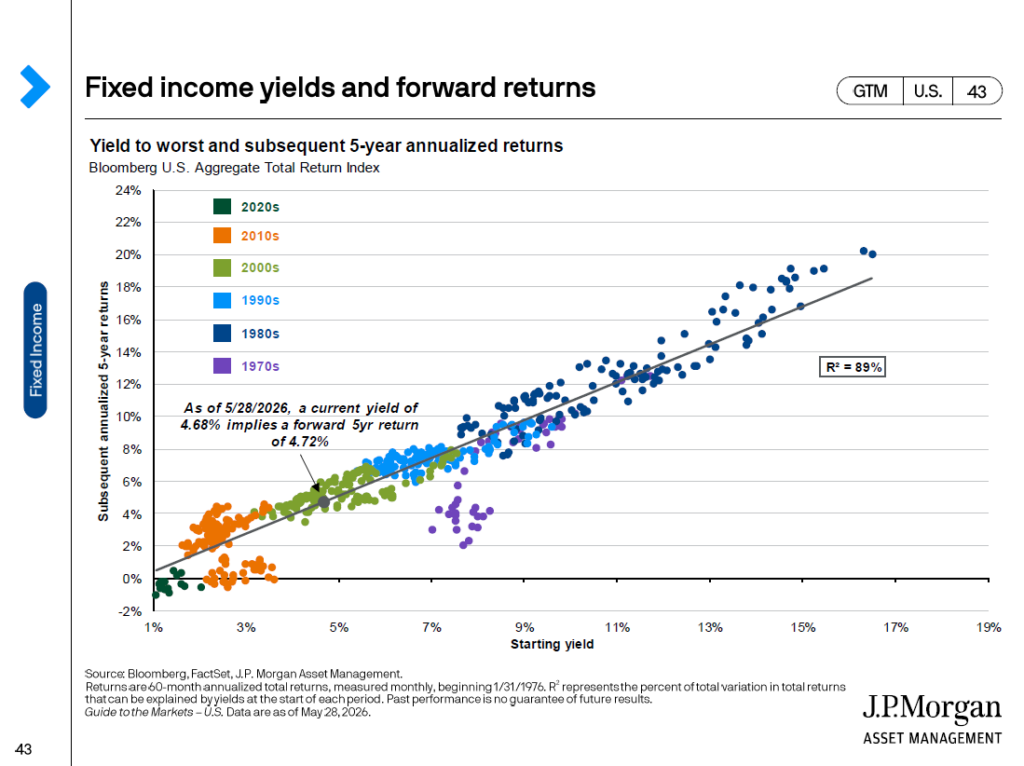
The chart above illustrates that across many different market and interest rate environments, the relationship has remained relatively consistent. Starting yields have historically provided helpful context for understanding potential long-term bond returns. Additionally, interest rate policies have differed among different decades, but your strongest correlation to your 5-year return is your starting yield. And in today’s environment, you can see that bonds may indicate that those returns are more in line with long-term historical averages.
Lastly, for investors, it’s an important reminder of the role bonds are designed to play within a portfolio. A shift to lower rates has led to discussions around tactical plays in the bond market, but bonds are meant to serve as a ballast in portfolios while equities are the growth vehicle.
Wrapping Up
While market headlines and interest rate expectations will continue to evolve, the core principles behind portfolio management remain unchanged.
At Connecticut Wealth Management (CTWM), our focus continues to be on long-term market trends, disciplined investing, and aligning investment strategies with each client’s financial plan.
Disclaimer: This information or presentation is for educational purposes only and should not be construed as personal investment advice. This should not be considered a recommendation of any particular investment strategy or security. Asset allocation and diversification may be used in an effort to manage risk and enhance returns however it cannot ensure profitable returns or protect against risk in any market environment. Investing involves risk and past performance is not indicative of future results. Please consult with your financial professional before making any financial decisions. This was prepared using third-party sources considered to be reliable; however, accuracy or completeness cannot be guaranteed. The information provided will not be updated at any time after the date of publication.