
Market headlines have shifted quickly throughout 2026, from geopolitical conflict and persistent inflation concerns to changing interest-rate expectations. Yet three-quarters of the way through the year, equity markets have remained resilient, bonds are offering yields investors have not seen in years, and private markets continue to attract growing interest.
Together, these developments reinforce an important lesson: while headlines may influence short-term sentiment, a thoughtful investment strategy begins with understanding the longer-term forces shaping markets.
In a recent discussion, Partner & Managing Advisor John Shanley and Chief Investment Officer Josh Sweeney explore what’s driving today’s market environment and why investors are increasingly looking beyond traditional public markets.
Big Headlines, Stronger Earnings
One of the most notable developments this year has been the gap between market headlines and performance.
While investors have been navigating a steady stream of news surrounding inflation, interest rates, energy prices, and geopolitical conflict, the underlying fundamentals of many businesses have remained relatively strong. Earnings expectations have continued to improve, helping support markets even as uncertainty dominates much of the daily news cycle.
Another encouraging trend has been the broadening of market participation. In recent years, much of the attention centered on the “Magnificent Seven,” a small group of large technology companies that accounted for a significant share of the S&P 500. This year, we’ve seen markets broaden, with contributions to performance from small capitalization stocks and emerging markets, areas that have lagged in recent years.
Headlines around inflation and rising Treasury yields have created volatility in the bond market, leading many investors to reconsider their bond positioning and explore money markets, CDs, and short-term Treasuries. At the same time, higher rates have created a new opportunity: more attractive income potential from bonds than investors have seen in years.
Not surprisingly, many investors have asked whether they should move assets into money markets, CDs, or short-term Treasuries. While these options may offer attractive yields today, those yields may not last indefinitely. If rates move lower, investors could be forced to reinvest maturing assets at reduced income levels, a challenge commonly referred to as reinvestment risk.
That distinction matters when comparing the yields available today with the role bonds may play over a longer time horizon.
Historically, starting yields have provided helpful context for understanding the potential long-term return environment for bond portfolios, as illustrated in the chart below. At CTWM, we consider those yields alongside reinvestment risk, liquidity needs, time horizon, and the role fixed income plays within each client’s broader financial plan.
Connecticut Wealth Management’s (CTWM) Investment Committee often references the chart below, which illustrates the historical relationship between starting bond yields and subsequent bond returns.
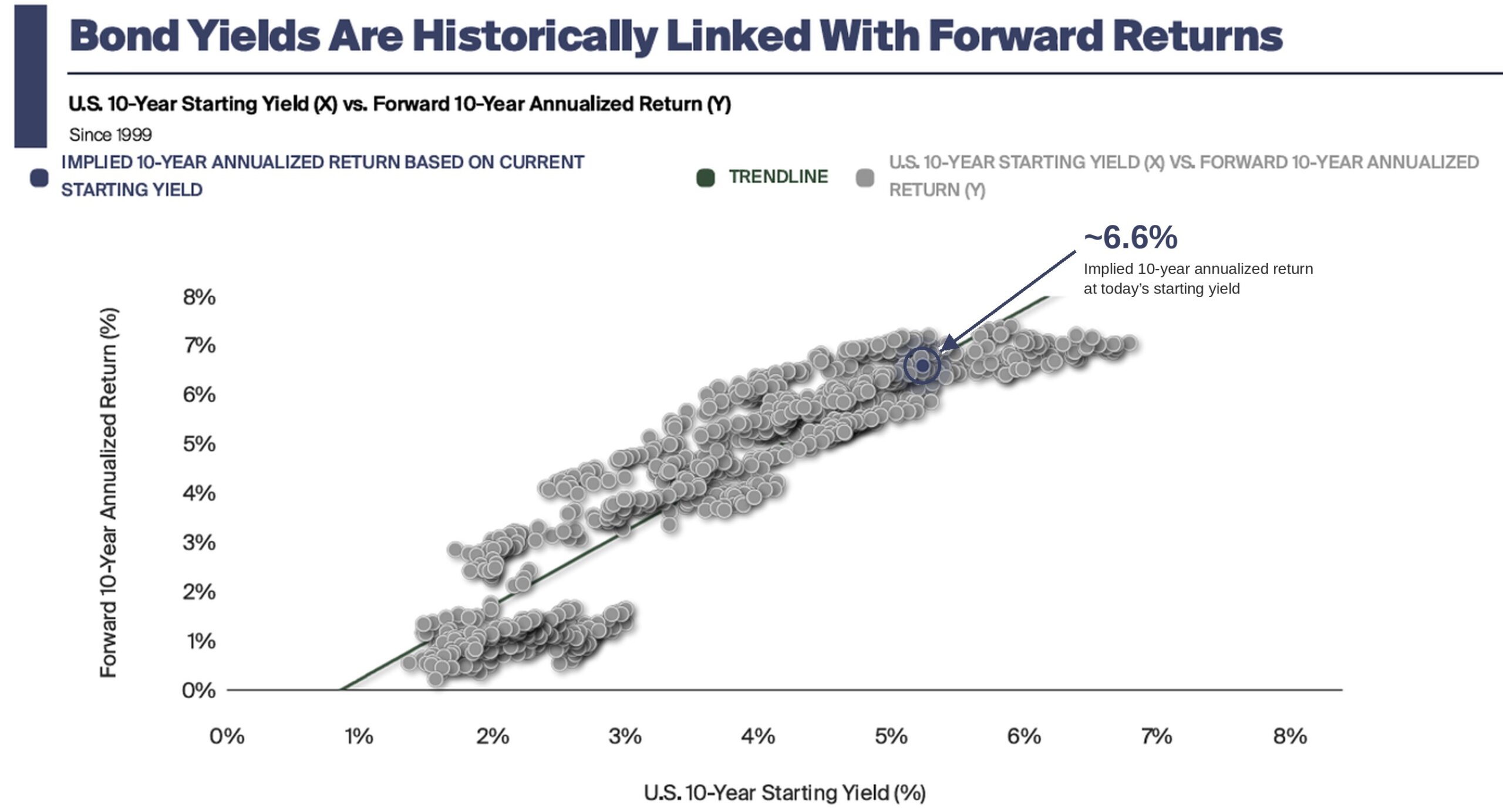
This slide is for informational and illustrative purposes only. The data provided is believed to be accurate, but there is no guarantee of its accuracy, completeness, or timeliness. This is not a recommendation or offer of any financial product. Past performance is not indicative of future results, and investors should consider their own objectives and risk tolerance. Indices, if presented, do not include fees, are unmanaged, and not available for direct investment. Definitions & Methodology: This chart plots the U.S. 10-Year Treasury starting yield against the subsequent 10-year annualized return using monthly observations since 1999. The starting yield is the yield to maturity on the benchmark 10-Year Treasury note. The forward return reflects the annualized total return realized over the following 10 years, including price changes and reinvested coupons; because this requires a full decade of forward data, the most recent plottable point ends 10 years prior to the latest date shown. The trendline is a best-fit linear regression describing the historical relationship and is not a forecast. The implied return is a single point estimate derived by applying the current starting yield to that historical relationship, shown for illustration only and not a prediction or guarantee.
Source: © Exhibit A, FactSet Research Systems Inc. | Latest: 2026-10-01
The right strategy depends less on today’s headlines and more on how each option fits within an investor’s goals, time horizon, and overall financial plan.
Time horizon is central to that evaluation. Volatility is a normal part of investing, whether it occurs in stocks or bonds, and short-term market movements may carry different implications depending on when an investor expects to need the money. Keeping that broader context in view can help investors evaluate opportunities without losing sight of the bigger picture.
Growing Interest in Private Markets
Developments in public markets also raise a broader planning question: where might investors find opportunities that complement their existing portfolios? That question, together with several high-profile IPOs in 2026, has contributed to growing interest in private markets.
The interest is understandable. Today, many successful businesses remain privately held far longer than in previous decades, allowing more of their growth and value creation to occur before they enter the public markets. In addition, more than 85% of companies with over $100 million in revenue are privately held.
As a result, investors are increasingly inquiring whether private market investments deserve a place within a diversified portfolio. For some investors, private market strategies may provide exposure to opportunities that are not available through public markets alone.
At the same time, private markets require careful evaluation and discipline. As more capital has flowed into the space, the number of investment managers and available strategies has expanded significantly. Not every opportunity offers the same experience, structure, or approach.
For that reason, manager selection remains an important consideration. Manager experience, investment discipline, portfolio construction, and access can all play a role when evaluating private market opportunities. In an increasingly crowded marketplace, understanding who is managing the investment may be just as important as understanding the investment itself.
Private investments also require patience. Unlike publicly traded securities, many private market strategies involve longer investment horizons and less liquidity—it takes time and effort to invest in a business and enhance its value. At CTWM, we evaluate these opportunities within the broader portfolio, considering manager selection, diversification, liquidity needs, time horizon, and alignment with each client’s financial plan and long-term objectives.
Maintaining Long-Term Perspective
Whether discussing stocks, bonds, or private investments, the message remains the same: successful investing is rarely about reacting to headlines.
Today’s market environment continues to present opportunities across a range of asset classes. Market participation has broadened, bond yields have become more attractive, and private markets provide access to areas of the economy that may not be available through public investments alone. At the same time, every opportunity comes with its own risks, tradeoffs, and considerations.
CTWM’s Investment Committee remains focused on evaluating these opportunities within the context of each client’s broader portfolio and financial plan. While headlines will continue to change, our approach remains grounded in disciplined investing, diversification, and an understanding of each client’s goals, time horizon, liquidity needs, and tolerance for risk.
Disclaimer: This information or presentation is for educational purposes only and should not be construed as personal investment advice. This should not be considered a recommendation of any particular investment strategy or security. Asset allocation and diversification may be used in an effort to manage risk and enhance returns however it cannot ensure profitable returns or protect against risk in any market environment. Investing involves risk and past performance is not indicative of future results. Please consult with your financial professional before making any financial decisions. This was prepared using third-party sources considered to be reliable; however, accuracy or completeness cannot be guaranteed. The information provided will not be updated at any time after the date of publication.